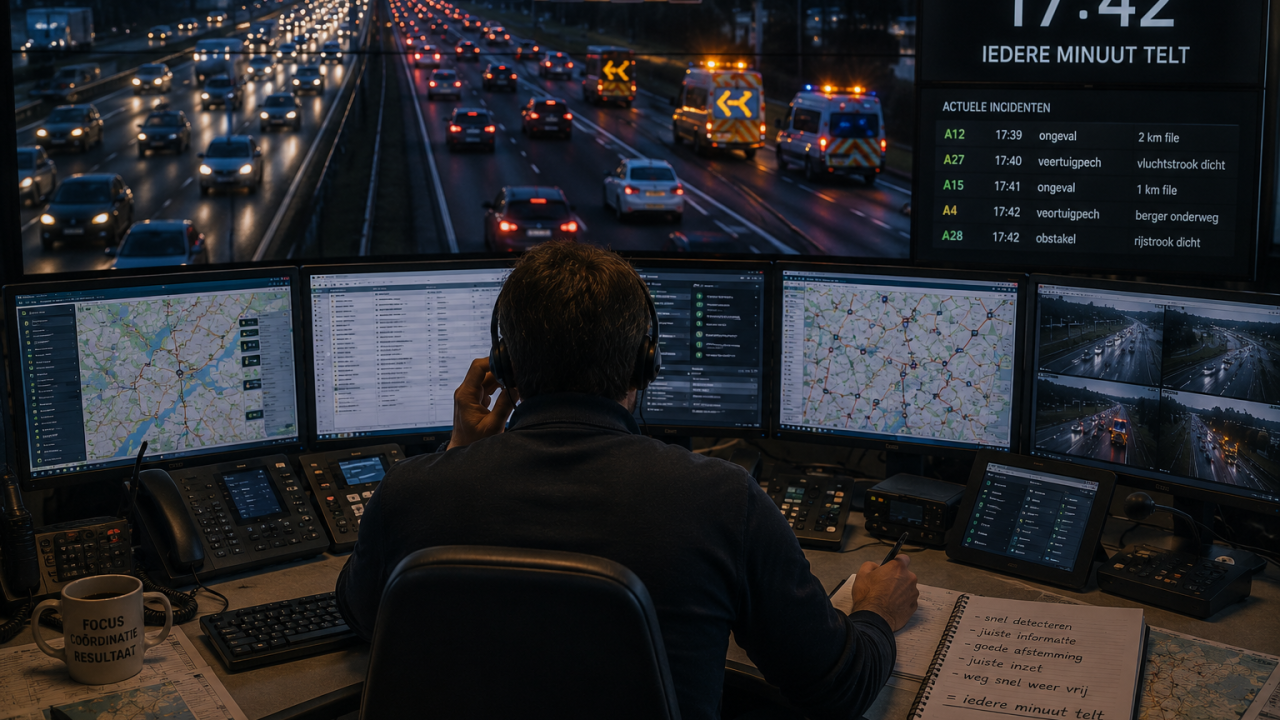
As agreed, I am completing the knowledge transfer for IM in the Cloud before the summer holidays. It is the Incident Management system currently used by all Rijkswaterstaat traffic control centres.
Perhaps the most important part of such a handover is not the technology, but the why behind the system. Why were particular design choices made? What lessons have we learned along the way? And which principles remain relevant after all these years?
This took me back through more than twenty-five years of documentation on Incident Management — from the earliest research reports and design notes to two complete system developments over the past fifteen years.
To my surprise, much of that documentation remained remarkably current. Not because technology has stood still, but because the fundamental principles of good Incident Management have hardly changed.
Since modern Incident Management was first conceived, research has shown that investing in rapid incident handling delivers an exceptionally high social return. The precise benefits vary by study, but the message has been remarkably consistent for decades:
Every minute saved creates value for society.
Not only because incidents are handled faster and congestion decreases, but also because more efficient incident handling directly contributes to the safety of responders and road users.
We have known this for years.
The question is therefore not whether we should continue investing in Incident Management.
The real question is:
Where will each euro invested deliver the greatest value for society?
Every minute begins on the operational floor
If every minute represents value for society, a second question automatically follows.
How do we design systems that help us actually recover those minutes?
After more than fifteen years developing Incident Management systems, one design principle has remained unchanged for me.
The objective should not be to make traffic operators work harder or faster.
It should be to remove everything that slows them down, allowing them to give the incident their full attention.
That naturally starts with reliability. An Incident Management system is mission-critical. When it is unavailable or slow to respond, incident handling ultimately slows down too.
I can say with some pride that almost fifteen years of practical experience have produced a platform with very high availability. Disruptions have naturally occurred, but strikingly often their cause lay outside the application itself — for example, in the underlying infrastructure or communication links.
Reliability alone, however, is not enough.
During the development of the first generation of Incident Management systems, around 2010, we already held extensive discussions with experienced traffic operators.
Strikingly, those conversations rarely concerned new functionality.
They focused mainly on what we should not do.
A recurring theme was avoiding or minimising unnecessary pop-up windows and other confirmation screens. In other words: never delay a traffic operator with unnecessary mouse clicks.
The reason was simple.
Every interruption costs time and disrupts both concentration and the traffic operator's flow of work.
Effective operational software demands as little of the traffic operator's attention as possible, so that maximum attention can go to the incident.
From recording to supporting
Perhaps this is the greatest change I have seen over the past fifteen years.
Increasingly, I realise that Incident Management's development so far can be divided into three clear generations.
The first focused primarily on local support. Each traffic control centre had its own internally developed systems, tools and working methods for recording and handling incidents.
The second brought national standardisation through UDLS. Consistent records, shared processes and systems ensured that everyone worked according to the same principles.
In my view, Rijkswaterstaat's traffic control centres have now reached the third generation with IM in the Cloud. The emphasis has shifted from recording to supporting. Automated process support and context-aware information provision are its main characteristics.
This development makes today's Incident Management system much more than a digital recording tool. It represents the first step towards a fully fledged decision support system.
Such a system's role is not just to record events, but to actively support the traffic operator while handling an incident.
Collecting relevant information.
Adding context.
And above all: presenting the right information at the right time.
Technology's role is not to replace the traffic operator.
It is to keep the traffic operator better informed, provide better support and reduce workload.
Where will we save the next few minutes?
But if we are honest, that third generation is not yet complete.
The automatic dispatch of road inspectors and recovery operators has demonstrated in recent years how much value for society can be created when technology genuinely becomes part of the operational process.
Yet I believe the greatest potential still lies ahead.
Not by giving the traffic operator more and more responsibility.
But by having the system take greater responsibility for routine support.
Precisely during the busiest parts of the day, technology can perform routine work automatically. This makes the best use of available operational capacity and lets traffic operators focus on decisions where human experience and insight truly make the difference.
If we know where value for society arises, the next logical question is:
Where, and through what means, might we save those next few minutes?
I see several possibilities.
- Truly simultaneous editing of the same incident by different traffic operators.
- Integrated use of real-time data on asset status, peak-hour and reversible lanes, and the availability of traffic management systems.
- Changing and cancelling light-vehicle recovery requests.
- Automating heavy-vehicle recovery operations and creating recovery case files.
- Real-time exchange of structured incident information between partner organisations.
- Direct visibility of expected arrival times for police, ambulance, fire and recovery services.
- Full support for Regional Incident Management, including provincial and municipal roads, special locations, S-routes and streets with hectometre markers.
- Automatic coordination of traffic management measures between neighbouring road authorities.
- Operator support based on weather conditions, road characteristics and incident complexity.
- Dynamic distribution of incidents according to priority and current workload, making better use of available operational capacity.
That last possibility, in particular, deserves more attention.
During rush hour, it is not unusual for one traffic operator to handle several complex incidents at once, while capacity is available elsewhere in the same or other traffic control centres. Dynamic incident allocation could make better use of that available operational capacity.
If a traffic operator unexpectedly becomes unavailable, a coordinating traffic operator often temporarily takes over the work. That is understandable, but reduces the time available for coordinating the overall operation.
Strikingly, the greatest challenges here are by no means always technical.
A good example is adding photos and videos to an incident file. Around 2010, we already demonstrated how easily this could be implemented technically. The added value for the traffic operator's situational awareness was immediately clear.
Yet the biggest challenge proved to be privacy legislation, ownership of the images and the legal frameworks for sharing that information, rather than the technology.
The same is true of many of the other examples mentioned above.
Much of this functionality has been technically prepared for years, or even fully developed. Today's greatest challenge lies less in the software than in the willingness to try new working methods in operations, embed them organisationally and then develop them further, step by step.
This is precisely where value for society sometimes remains unrealised. Not because the technology is missing, but because innovations only create value once they actually become part of everyday operations.
Perhaps this is the most important lesson I draw from more than twenty-five years in Incident Management.
Technological progress rarely comes from starting again and again.
It comes from consistently developing existing ideas and actually using the capabilities already available today.
Towards the fourth generation
For precisely that reason, I believe Artificial Intelligence belongs in a fourth generation of Incident Management.
Not because AI replaces the current generation of Decision Support, but because it builds upon it.
The third generation moved from recording to supporting. Decision Support, automated process support and context-aware information provision are its main building blocks.
At the same time, we have seen that a significant part of that third generation remains unfinished. Many capabilities have been technically available for years but have reached everyday operations only partially, or not at all.
I therefore do not believe the next step is to leave the third generation behind.
The next step is to finish it first.
That means further developing Decision Support, extending operator support, enabling real-time information exchange between partner organisations and actually testing these capabilities in an operational setting.
Only when that foundation is solid will there be room for a fourth generation, in which AI complements existing Decision Support with self-learning models that recognise patterns, make predictions and continue developing through operational experience.
That will not be a revolution.
It will be a logical evolution.
Perhaps we should therefore assess future technical investments less on manageability, integration or the number of new features.
Perhaps we should keep asking one simple question above all.
Will this investment ultimately help us reopen the road a few minutes sooner after an incident?
Because value for society does not arise in the traffic control centre.
Nor in the data centre.
It arises when the road can be reopened a few minutes sooner after an incident.
Perhaps this is the most important lesson I draw from more than twenty-five years in Incident Management.
New technology does not create value for society simply because it is more modern, smarter or more innovative.
It creates that value when it helps traffic operators make better-informed decisions, accelerate incident handling and safely reopen the road a few minutes earlier.
Because ultimately, every minute counts.