
I have just archived the final documentation. This brings five intensive years with IM in the Cloud to a close, as I say goodbye to Rijkswaterstaat and to a field I have had the pleasure and privilege of serving.
I am now truly retired. My ABP pension is arranged; my Dutch state pension will follow here in Spain through the familiar bureaucratic detour — that will take a few more months.
As I write this, it is January 2026. Time moves on, yet the challenges in traffic management remain remarkably familiar, and some planned innovations are progressing considerably less quickly in practice than they appeared to on paper.
IM in the Cloud — working on what is actually needed
IM in the Cloud was never intended to be an all-encompassing system. It was a practical solution for one clear traffic management objective: supporting operational incident management — reliably, at scale and with as little unnecessary baggage as possible.
IM in the Cloud entered operational use within the DTP project, where limited resources, considerable expertise and close collaboration enabled it to make a stable contribution to the operational IM chain. Incidents are handled and operational continuity is supported.
It is technology that stays close to its users, built around the daily reality of traffic control centres. Its starting point was not just an architecture diagram, but above all the question: what does a Dutch traffic operator need right now to do the job well in practice?
But the success of IM in the Cloud is not just about technology. Equally important is the swift, expert and direct support provided to its end users — the traffic operators themselves. When something goes wrong, it is solved rather than simply absorbed into a process.
Those short lines of communication and that sense of shared ownership contribute to the system's reliability and to its appreciation in operations, while naturally leaving room for further improvement.
And it is important to emphasise that IM in the Cloud is not alone in this.
Over recent years, various suppliers have developed systems — each with expertise, vision and commitment, often in close collaboration with and for the people working in operations.
Like IM in the Cloud, however, this work took place under the continuing shadow of the CHARM programme: a major migration that has hung over the field since 2015.
That shadow has had, and partly continues to have, two very practical consequences: available budgets were swallowed up by CHARM for years, and innovative ideas were repeatedly held back by the argument that ‘CHARM must eventually be able to do this too’. Further innovation therefore required alignment with CHARM and was effectively postponed.
Despite this limited room for both funding and innovation, these projects continued to deliver, improve and provide support — often with a tangible and immediate impact on operations.
Together, they demonstrate that innovation in traffic management does work, provided it stays close to operational practice and its users.
A particular dynamic emerged when functionality developed within the DTP project — with limited resources and close to operations — was later reimplemented within CHARM as part of an additional release. Comparable functionality will therefore be presented as a programme achievement within CHARM, although it originally came into being outside the programme.
For those involved in DTP, this is a striking observation, particularly given the scale and deployment of external expertise within CHARM.
The contrast is even clearer in the development time. The DTP reimplementation within CHARM has now been in development for more than two years, while the original DTP project implemented that functionality quickly and effectively — within a few months — in its original technical environment. A sharp contrast with the technical and organisational complexity confronting CHARM.
Although the CHARM implementation, Dynac, is now operational at all traffic control centres — and several releases have even been rolled out in the south of the Netherlands — this DTP functionality is still not available in operational use within Dynac.
The quiet but persistent pressure of the ‘mega-system’
According to official Rijkswaterstaat information, CHARM is intended to modernise traffic management in the Netherlands through one shared platform that is future-proof, cost-effective and efficient.
An ambitious programme, with substantial budgets, dozens of professionals and — perhaps more importantly — unlimited political backing.
But reality proved more difficult.
- The CHARM programme originated in an initial market exploration in 2011 and formally began around 2015, making it one of Rijkswaterstaat's longest-running ICT migration programmes.
- Following several revisions of its completion date — from approximately 2018 to the current end of 2026 — we are formally looking at a project finishing eight years later than initially planned. That end date should now primarily be seen as a management assumption rather than a realistic planning prospect.
- As the completion date keeps shifting, the original objectives gradually become blurred, and precise requirements and design choices have increasingly been adjusted to the circumstances of the day.
- In ICT projects, time is not neutral: every additional year makes technology older, requirements less clear and dependencies greater. In 2026, the architecture underpinning the programme is estimated to be more than fifteen years old. The platform has therefore missed a whole generation of technological developments — from integrated spatial support to modern integration and security standards.
- Those shifting requirements and the long duration have led not only to complexity and delay, but also to budget increases and a growing distance from the original user need.
As an aside: publications such as Binnenlands Bestuur pointed at the time to coronavirus restrictions as a cause of further delay. Interestingly, DTP emerged during precisely the same period — developed entirely remotely and successfully delivered within a few months. The contrast shows how differently projects can respond to the same circumstances.
That growing distance from reality was later confirmed by the Adviescollege ICT-toetsing (Advisory Council on IT Assessment)…

In its April 2023 advice, the council identified structural risks: dependence on a single supplier, an outdated contractual basis, and the need to keep existing systems running longer to safeguard continuity in traffic management.
The audit critically assessed both the supplier and Rijkswaterstaat: the supplier for its technical delivery, and Rijkswaterstaat for a lack of clear direction and consistent commissioning.
Seen in this light, technical difficulties cannot be attributed solely to the implementing party. They also stem from broader structural choices concerning the formulation of the assignment, available domain knowledge and substantive direction throughout the project.
The council explicitly advised Rijkswaterstaat to focus more sharply on realism, phasing and end-user involvement — and even to be prepared to stop CHARM if the crucial A2 phase was not operational at all traffic control centres by 2024 at the latest.
In the subsequent letter to Parliament of 11 May 2023, the possibility of stopping was left out of the picture. Other recommendations — stronger governance, extra capacity and a fallback scenario — were adopted. This confirmed the course: not stopping, but maintaining control. Strikingly, no concrete or binding deadlines accompanied that decision, leaving the necessary focus on time and results largely absent.
The content of that letter understandably reflected the picture prevailing within the programme at the time — a perspective focused mainly on progress and continuity, and less on reconsideration or a change of course. Within that context, the project gradually shifted from substance to image.
The focus is no longer on technology or results, but on perception — the image that the project is progressing well following some recommended adjustments. And perception is lethal to any major ICT project: once you start managing assumptions and appearances rather than what is actually needed, you inevitably lose touch with reality.

Now, almost three years later, we can see the outcome of that decision. The promised breakthroughs have not materialised, the advice to stop was not followed, and operational dependence on legacy systems and supposedly ‘temporary’ solutions that have become structural — including IM in the Cloud — is greater than ever.
What really matters
What seems to have been forgotten along the way is that technology is not an end in itself. The success of a traffic control centre does not depend on a programme's size or a system's status, but on how well it fits the reality of the work: clarity, reliability and speed for the people doing the job.
In that reality, traffic operators are the most important holders of knowledge. Yet their voice in decision-making has grown quieter over recent years — not because they have nothing to say, but because the system gradually silences them through processes, meeting structures and protocols. Operational practice is heard, but rarely truly listened to.
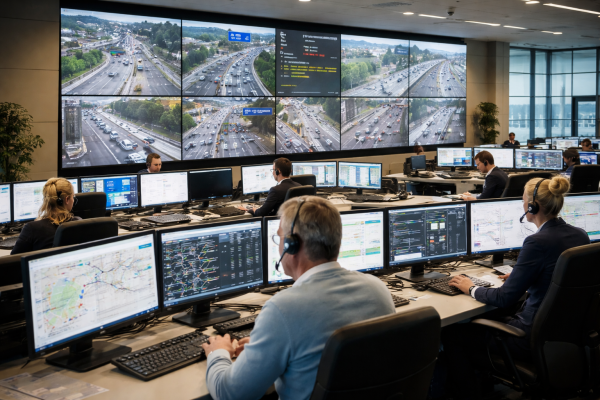
As long as we continue designing from behind a desk rather than from the workplace, every system will sooner or later stumble over its own ambition.
Time for renewed trust
Perhaps it is time for Rijkswaterstaat to follow the Advisory Council on IT Assessment's advice after all — out of respect for the traffic operators who make a difference every day, often despite the technology rather than because of it.
That requires recognising that holding on does not always mean being steadfast, and that stopping can sometimes be the most courageous and constructive choice. At the same time, the way forward is not always a choice between stopping and continuing, but one of recalibration — together, in open discussion with the people who work with the consequences every day.
Rijkswaterstaat innovates on many fronts. But perhaps, for the core technology of traffic control centres, it is time to trust again in the creativity, innovation and strength of the Dutch traffic industry. Not by starting another mega-programme, but by strengthening what already works and enabling genuinely open collaboration around knowledge, data and infrastructure.
A more service-oriented way of thinking and working creates room for another approach: developing clearly bounded traffic management modules that are logical, manageable and able to evolve. Modules that work together, reinforce one another and ultimately form the platform CHARM should have become — without the vulnerability of one monolithic solution that rapidly ages.
It is a move from large to smart, from centralised to collaborative, and from all-in-one to precisely what is needed.
Only then can we prevent dependence on one mega-system from becoming a structural vulnerability that actually obstructs innovation.
Because sometimes the solution is not abroad or in the future, but right here — today — under our own noses.
For me, the story of IM in the Cloud is complete. It has been handed over and is being taken forward in good hands — while CHARM continues undisturbed, largely unaffected by developments around it.
To everyone involved in CHARM: now that the new year has begun, I hope 2026 offers room for reflection — listen less to political and administrative perceptions, and more to the end user in operations. Because that is where the difference between movement and meaningful progress ultimately lies.
Sources
- Rijkswaterstaat — CHARM ATMS
- Binnenlands Bestuur — major public-sector ICT projects
- Dutch Government ICT Dashboard — CHARM
- Advisory Council on IT Assessment, advice on the CHARM programme, April 2023
- Letter to Parliament of 11 May 2023, reference RWS-2023/12436
- Report on Major ICT Activities 2022
- Report on Major ICT Activities 2023
- Report on Major ICT Activities 2024
- … and, of course, five years of professional astonishment …